Introduction
At Sin Chew, we understand that the aviation supply chain depends on far more than moving parts from one location to another. Engines, landing gear, avionics and precision tooling must reach the right facility safely, on schedule and in line with strict industry requirements.
The same applies to manufacturing machinery, testing equipment, ground support systems and composite production tools. Their size, sensitivity and value can make conventional freight methods unsuitable, particularly when access, handling or delivery conditions are complex.
As aviation manufacturing and maintenance activities expand, logistics teams must manage tighter maintenance, repair and overhaul (MRO) schedules, sensitive equipment, cross-border documentation and increasingly complex site conditions. At the same time, growing aircraft fleets, higher production targets and increasing demand for MRO capacity are placing greater pressure on the aviation supply chain to deliver equipment safely, efficiently and without disruption.
Our role is to integrate these technical, operational and logistics requirements into a single coordinated execution strategy, helping manufacturers, MRO providers and aerospace operators reduce risk while maintaining operational continuity.
Sin Chew was invited to join and is now a member of the Association of Aerospace Industries (Singapore). This reflects our continued commitment to supporting aerospace manufacturers, MRO operators and engineering organisations through specialised logistics, equipment handling and export packaging solutions.
Key Takeaways:
- The aviation supply chain relies on close coordination between manufacturers, suppliers, maintenance providers and transport teams across multiple countries.
- Sensitive aircraft components and production equipment often require custom packing, controlled lifting and carefully planned transport.
- Site surveys and equipment assessments help identify access limits, lifting needs and delivery risks before work begins.
- Well-planned export packing protects valuable assets against vibration, impact, moisture and contamination during storage and transit.
- Specialised logistics helps reduce disruption by aligning technical requirements, site conditions and delivery schedules.
How the Aviation Supply Chain Works
The aviation supply chain begins well before an aircraft reaches the runway. Raw materials are turned into specialised components by manufacturers across several tiers, with each part moving through assembly, testing and quality checks before installation.
The process continues throughout the aircraft’s service life. Maintenance, repair and overhaul facilities depend on a steady supply of replacement parts, diagnostic tools, ground support equipment and engineering resources. When deliveries are delayed, maintenance schedules can be affected and aircraft may remain out of service for longer than planned.
Keeping the aviation supply chain resilient and efficient moving requires close coordination between:
- Aircraft manufacturers and component suppliers
- Maintenance, repair and overhaul organisations
- Aerospace research and development facilities
- Advanced composite manufacturers
- Airport operators and infrastructure contractors
- Regulatory and customs authorities
- Engineering teams and logistics providers
Each party supports a different stage of production, maintenance or operations, so disruption in one area can quickly affect the rest of the network, creating knock-on effects across production schedules, maintenance programmes and service commitments.
A delayed machine installation, for example, may hold up a production line. A replacement component that arrives late or damaged may also delay an aircraft’s return to service. Proactive planning, stakeholder alignment and dependable logistics execution are therefore essential throughout the aviation supply chain, particularly when critical equipment movements directly support revenue-generating aircraft operations.
Why Aviation Equipment Requires Specialised Handling
We know that aviation equipment cannot be handled like conventional cargo movements.The financial and operational consequences of damage or delay can be significantly higher than those associated with conventional industrial cargo. Aircraft engines, landing gear, rotor components, avionics systems and composite structures may be highly sensitive to vibration, impact, moisture, dust and contamination.
Manufacturing and maintenance equipment can be just as operationally critical. Some machines have irregular dimensions, high centres of gravity or delicate internal components, while others must remain in a fixed orientation or be handled under cleanroom-compatible conditions.
Even slight movement during transit can affect calibration, damage connectors or place stress on precision parts, potentially creating issues that only become apparent during installation, testing or commissioning. In some cases, the problem may only become apparent during unpacking, testing or commissioning, when delays are already harder and more costly to manage.
Depending on the asset, our handling approach may include:
- Custom-designed crates and protective cases
- Internal supports shaped around the equipment
- Shock and vibration protection
- Moisture barriers and desiccants
- Contamination-controlled packing
- Engineered lifting and rigging plans
- Air-ride or shock-controlled transport
- Climate-controlled storage
- Real-time fleet and cargo monitoring
The methods used depend on the asset and site. CAD-supported crate design may be needed for irregular components, while hydraulic skidding systems, battery-powered rollers or air float systems can support controlled movement where conventional lifting equipment has limited access, helping reduce handling risks while maintaining greater control over sensitive aerospace assets.
Common Challenges Across the Aviation Supply Chain
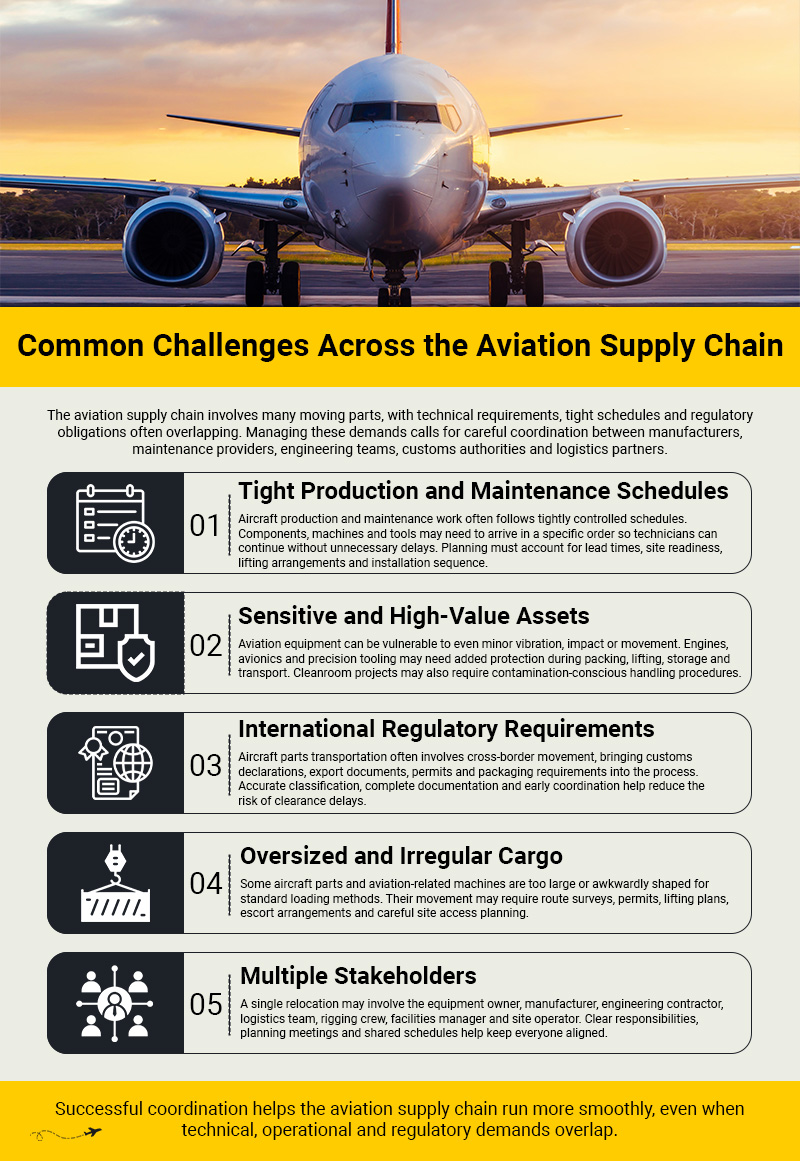
The aviation supply chain involves multiple interconnected stakeholders and operational dependencies, with technical requirements, tight schedules and regulatory obligations often overlapping. Managing these demands calls for careful coordination between manufacturers, maintenance providers, engineering teams, customs authorities and logistics partners.
Tight Production and Maintenance Schedules
Aircraft production and maintenance work often follows tightly controlled schedules. Components, machines and tools may need to arrive in a specific order so technicians can continue without unnecessary delays.
Arriving too early can create storage or access problems, while arriving late may hold up engineers and affect the stages that follow. Planning must therefore account for lead times, site readiness and the order in which each item is needed, rather than treating the delivery as an isolated movement. Successful aviation logistics depends on understanding how equipment movements affect the wider production, maintenance and operational schedule.
Sensitive and High-Value Assets
Aviation assets can be vulnerable to relatively minor movement, impact or environmental exposure. Damage to an engine, avionics system or precision tool may only become apparent during testing or commissioning, when the effect on the project is already more difficult to contain.
Cleanroom projects add another concern. The packing materials, movement method and handling procedures may all need to support contamination control so the equipment reaches the next stage ready for use.
These precautions are especially important across the aviation supply chain, where damage to a single critical asset can affect testing, installation or operational schedules, potentially creating costly downstream disruptions that extend beyond the immediate project.
International Regulatory Requirements
Aircraft parts transportation often involves cross-border movement, bringing customs declarations, export documents, permits and packaging requirements into the planning process.
Accurate classification and complete documentation help reduce the risk of clearance delays. Wooden export packaging may also need to meet applicable phytosanitary standards, depending on the destination.
Clear coordination between the shipper, consignee, freight representatives and customs personnel helps resolve potential issues before the cargo reaches the port or airport, reducing the likelihood of avoidable compliance or clearance issues.
Oversized and Irregular Cargo
Some aircraft parts and aviation-related machines are too large or awkwardly shaped for standard loading methods. Their movement may require route surveys, permits, lifting plans, escort arrangements or temporary changes to site access.
The receiving location must also be assessed carefully. Door widths, ceiling heights, floor loading limits, turning space, loading bay access and crane positioning can all affect how the cargo is delivered and moved into place.
Early assessment of these constraints helps reduce unexpected delays, rework and operational disruption during delivery and installation.
Multiple Stakeholders
A single relocation may involve the equipment owner, original manufacturer, engineering contractor, logistics team, rigging crew, facilities manager and site operator.
When responsibilities are unclear, essential preparations can be missed. These may include disconnecting utilities, confirming lifting points, preparing foundations or clearing the installation area.
We use planning meetings, clear task allocation and shared schedules to keep everyone aligned before, during and after the move. This level of coordination helps the aviation supply chain operate more smoothly when several parties are involved, particularly when project timelines, technical requirements and site activities must be carefully synchronised.
The Role of Specialised Logistics in Aviation
Specialised logistics brings the technical and operational sides of an aviation move together. As aviation facilities become increasingly automated and equipment grows more complex, logistics planning plays a greater role in project success than ever before. Manufacturers, MRO providers, engineers, rigging teams and site personnel may all be involved, and their work must be aligned around the condition of the asset, access constraints and the required delivery sequence.
A coordinated plan helps mitigate operational risks before mobilisation. These may include premature deliveries, a packed asset being too large for the final access route or lifting equipment being unsuitable for the available space.
Addressing these issues during the planning stage helps reduce disruption, improve resource utilisation and maintain project momentum throughout the relocation process.
Supporting Aircraft Manufacturing and Maintenance Operations
Aviation manufacturing relies on more than the delivery of finished aircraft parts. Production facilities also depend on machinery, composite manufacturing tools, testing systems, jigs, fixtures and other specialised equipment.
These assets may need to be relocated when:
- A new production line is being set up
- Existing production capacity is being expanded
- Machinery is transferred between regional facilities
- Equipment is sent overseas for upgrading or servicing
- A manufacturing plant or laboratory is reorganised
- An MRO facility introduces new maintenance capabilities
Before work begins, we assess the equipment, confirm access conditions and determine the order in which each asset must be removed, transported and positioned.
This is especially important in MRO logistics, where relocation work may need to take place around ongoing maintenance activity. A poorly timed delivery can block access, interrupt work or leave equipment waiting before installation. Careful sequencing helps reduce these conflicts and supports the wider aviation supply chain, helping facilities maintain operational continuity while maximising equipment availability and utilisation.
In highly regulated aerospace environments, effective sequencing is not simply about efficiency. It also helps minimise operational risk, supports site productivity and enables critical maintenance or manufacturing activities to continue with minimal disruption.
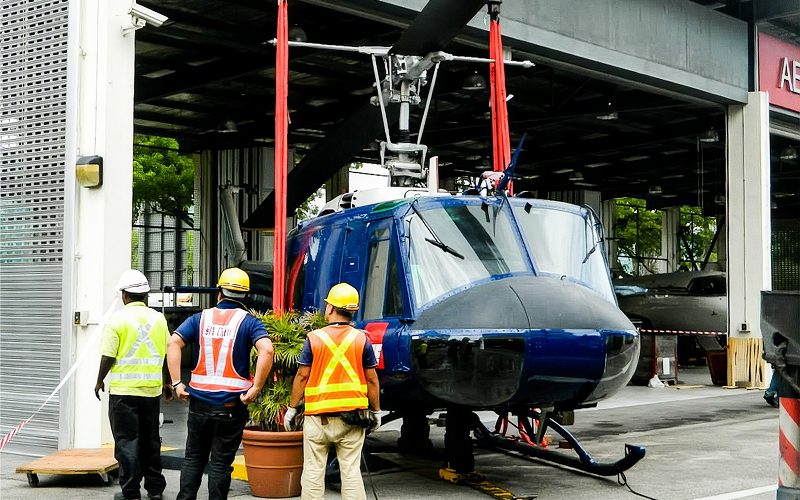
Case Study: Relocating Complete Aircraft
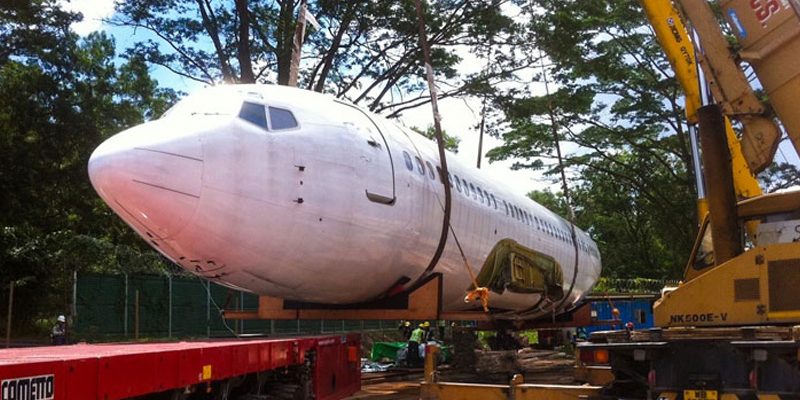
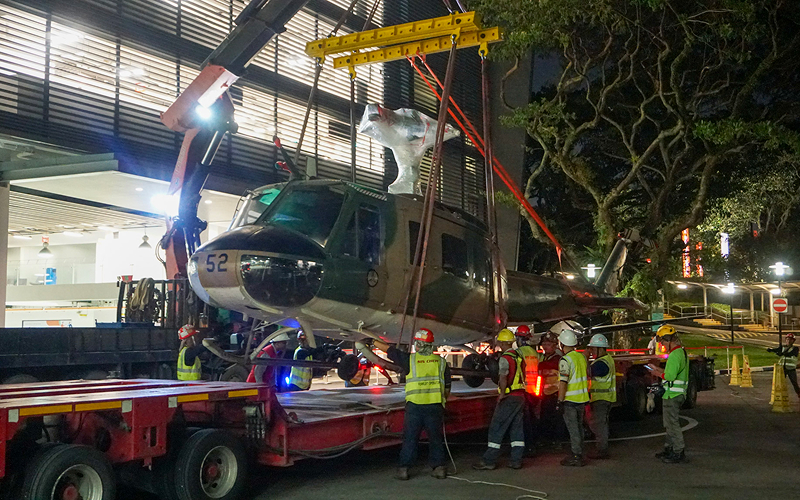
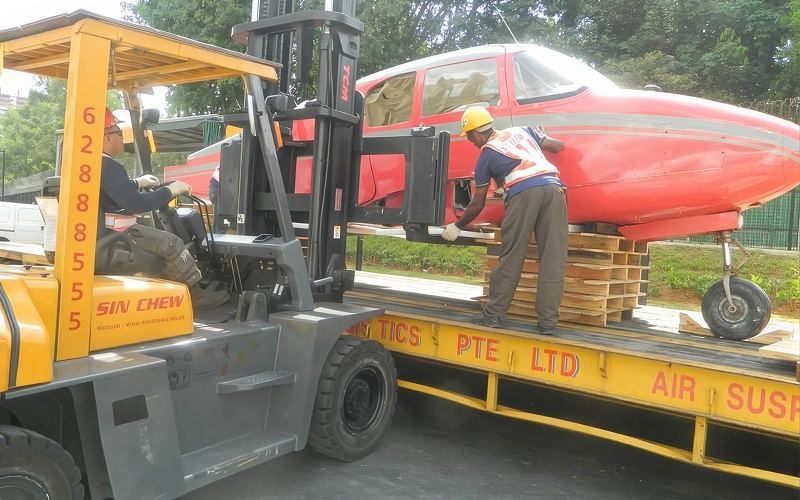
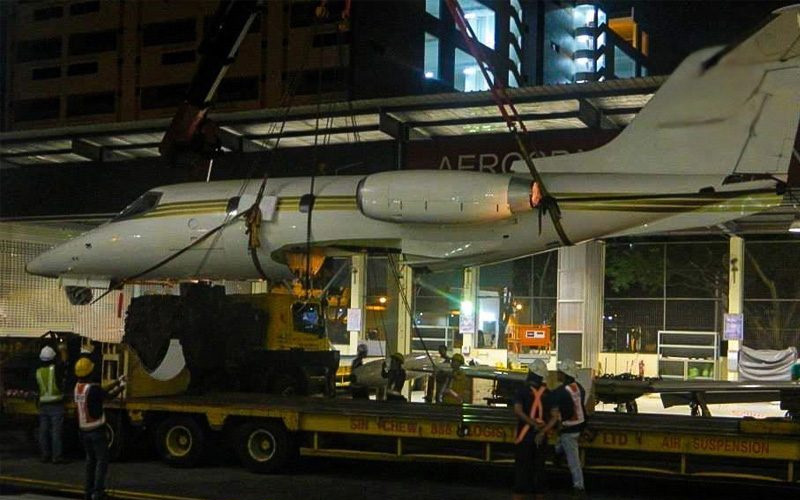
Moving a complete aircraft requires more than selecting a suitable transport vehicle. Its weight must be supported at the correct points, while exposed structures need protection throughout lifting, loading and ground movement.
From our experience of handling fixed-wing aircraft and helicopter relocations, every move required a different arrangement based on the aircraft’s geometry, available access and the condition in which it needed to be transported.
For fixed-wing aircraft, planning may involve checking whether the wings or other sections need to be removed to meet road and site clearance limits. Helicopter movements may require rotor blades to be detached and packed separately, while the fuselage is supported on a purpose-planned frame.
The route must also be checked for turning space, overhead obstructions and suitable crane or lifting positions. These assessments help prevent the aircraft from reaching a point where it cannot proceed or be unloaded as planned.
This is what distinguishes project logistics from traditional freight transportation. The vehicle is only one part of a wider operation involving support, access, lifting and controlled movement.
Success depends not only on transportation but also on engineering assessments, lifting strategy, route planning, site readiness and stakeholder coordination.
For complete aircraft relocations, careful preparation helps reduce operational risk, protect critical structures and ensure the aircraft reaches its destination in the required condition.
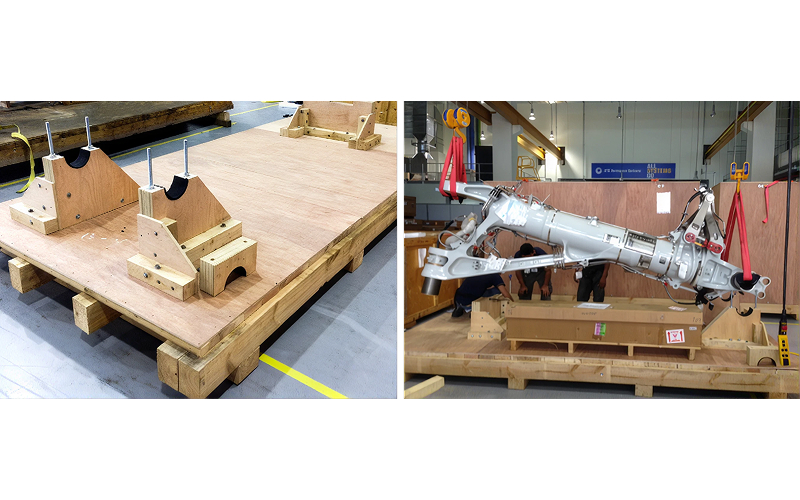
Case Study: Aircraft Component Packing and Crating
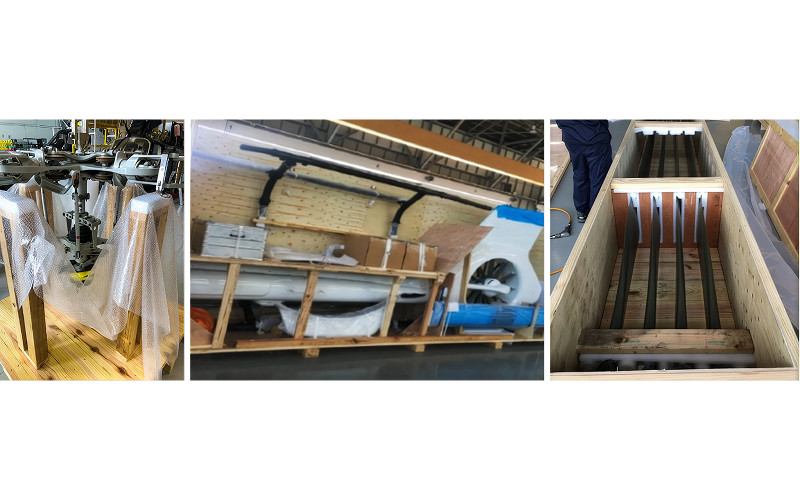
Aircraft components rarely fit neatly into standard crates. Landing gear, rotor hubs and rotor blades each have different support points, weight distribution and areas that should not bear load.
We have designed and produced customised crates for landing gear, helicopter rotor hubs, rotor blades, landing skids and other aviation components.
For a landing gear project, the internal supports were arranged to hold the component securely without placing pressure on exposed fittings or sensitive areas. The base also needed to distribute the load evenly and remain stable during forklift handling and container loading.
Rotor blades present a different risk. Their length and narrow profile make them vulnerable to flexing if the supports are spaced incorrectly. The crate must therefore control movement across the entire component rather than securing only its ends.
Rotor hubs, by contrast, are compact but heavy. Their crates may require reinforced bases, low centres of gravity and clearly marked lifting access to remain stable during repeated handling.
These examples show why packaging design must account for more than dimensions. The asset’s geometry, balance, fragility and expected handling conditions all influence how the crate is built, particularly for aerospace components where even minor movement, vibration or load transfer can affect asset integrity.
Well-designed export packaging helps reduce avoidable handling risks while supporting safer lifting, transportation, storage and installation throughout the aviation supply chain.
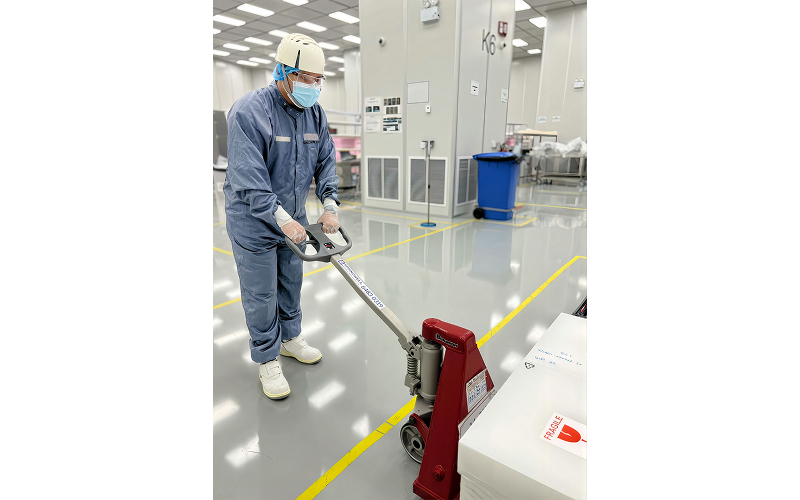
Case Study: Aviation Tool and Equipment Relocation
Aircraft manufacturers and MRO facilities use specialised tools for inspection, repair, testing and component assembly. Some contain calibrated systems, while others must be moved into cleanrooms or through areas with limited crane and forklift access.
Our experience includes engine relocation and installation, avionics tool movements, cleanroom packing for composite tools and equipment consolidation for aerospace organisations.
A typical equipment relocation begins by confirming the machine’s dimensions, centre of gravity, lifting points and utility connections. The movement path is then checked for narrow entrances, floor loading limits, overhead restrictions and changes in level.
Where conventional lifting equipment cannot enter, hydraulic skidding systems, battery-powered rollers or air float systems may be used. The choice depends on the machine’s weight, floor condition and available manoeuvring space, as well as the level of movement control required throughout the relocation process.
For multi-machine projects, the removal and installation order must also be coordinated carefully. Moving one asset too early can block access for another, while incorrect positioning can make later utility connections or commissioning more difficult.
Successful equipment relocation depends not only on moving each asset safely but also on understanding how individual movements affect the wider installation sequence, commissioning schedule and facility operations.
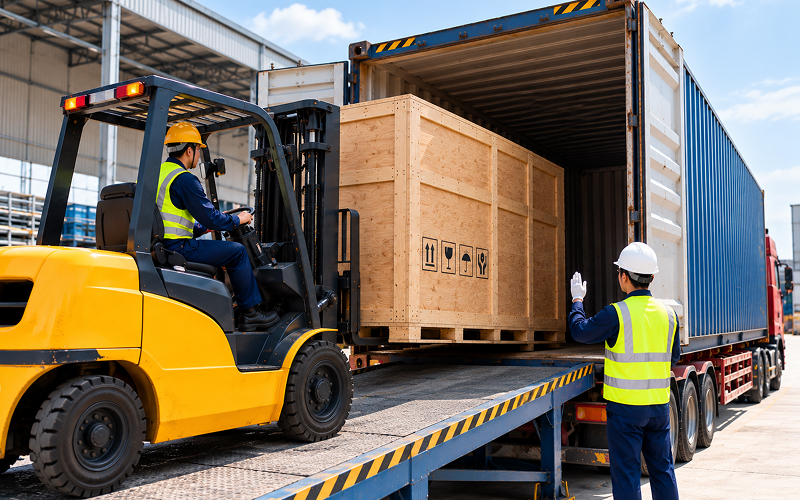
Why Export Packing and Transport Planning Matter
Export packing safeguards high-value protects aviation equipment from the conditions it may face during handling, storage and international transport. Before reaching its destination, an asset may be lifted several times, stored in a warehouse, loaded into a container, transferred through a port and moved by road. Changes in temperature and humidity can add further risk along the way.
Depending on the equipment, the packing system may include:
- Heat-treated timber where required
- Reinforced skids and load-bearing bases
- Custom blocking and bracing
- Moisture barriers, desiccants and humidity indicators
- Shock-absorbing supports
- Anti-static protection for electronic systems
- Sealed or contamination-controlled packaging
- Clear lifting and handling markings
Large, heavy or sensitive assets may require engineered packaging. Our capabilities include CAD-supported crate design, shock mitigation and finite element analysis for selected structures. Reusable cases may also suit equipment that moves regularly between facilities, helping improve long-term asset protection and lifecycle cost efficiency.
Transport planning should take place alongside crate design. Packaging decisions influence transportation requirements, just as transportation constraints influence packaging design.The finished crate must protect the asset while still fitting through access points and remaining compatible with the vehicle, lifting equipment and shipping method.
A specialised aerospace logistics provider must therefore consider packed dimensions, container loading, route clearance and destination handling before fabrication begins. This is especially important across the aviation supply chain as it prevents a crate from protecting the equipment during transit but creating difficulties during unloading.
When packaging and transport planning are developed together, potential handling, access and delivery challenges can often be identified and resolved much earlier in the project lifecycle.

Building an Integrated Aviation Logistics Plan
A well-planned aviation logistics project covers the full journey, from the first assessment to final positioning. The most successful projects are built around a single integrated plan rather than separate handling, transport and installation activities managed in isolation. The following stages bring the technical, transport and site requirements into one coordinated process.
Site Survey and Equipment Assessment
The process starts with gathering accurate information. A site survey helps us confirm:
- Equipment dimensions and weight
- Centre of gravity and lifting points
- Packing and environmental requirements
- Access at the origin and destination
- Floor loading restrictions
- Crane, forklift or rigging needs
- Temporary storage requirements
- Installation sequence
- Permit or traffic management requirements
Photographs, drawings and equipment records can support the assessment, although an on-site inspection may still be needed for more complex moves.
Early assessment helps identify operational constraints before mobilisation begins, allowing project teams to address potential access, safety and scheduling issues before they affect execution.
Engineering and Packing Design
Once the equipment has been assessed, we can determine the most suitable protection method.
Aerospace assets may require custom crates, transport frames, vacuum barriers or cleanroom-compatible wrapping. The design must also consider how the equipment will be lifted, secured and unpacked.
CAD drawings allow the project team to review internal supports, crate dimensions and access requirements before fabrication begins, helping reduce the risk of design conflicts during transportation, unloading and installation.
Lifting and Rigging Planning
A lifting plan should set out the equipment to be used, lifting capacity, attachment points, movement path and responsibilities of each team member.
Controlled movement is especially important for sensitive assets. Uneven lifting or sudden changes in direction can place unnecessary stress on the equipment.
Where overhead lifting is unsuitable, alternatives such as hydraulic skidding systems, rollers or air bearings may be used to move equipment through confined areas or across sensitive floors.
Detailed lifting and rigging planning helps improve safety, minimise equipment stress and provide greater control throughout critical movement operations.
Transportation and Monitoring
Vehicle selection depends on the asset’s packed dimensions, weight, sensitivity and planned route.
Air-ride suspension can help reduce vibration during transit, while GPS and command centre monitoring provide greater visibility over vehicle movements and route conditions.
Real-time fleet monitoring, route optimisation and live vehicle tracking provide greater visibility during transit. Driver behaviour monitoring and proximity sensors can also support safer vehicle movements, helping project teams respond more effectively to changing site or transport conditions.
Delivery, Positioning and Installation Support
The work continues after the vehicle arrives. The equipment still needs to be unloaded, moved into position and prepared for installation or commissioning.
Destination planning confirms that access routes are clear and that the required personnel and lifting equipment are ready. The equipment may also need to arrive in a specific orientation to support installation.
Close coordination at this stage helps reduce waiting time and keeps each activity moving in the planned order, supporting a smoother transition from delivery to installation and operational readiness.
The Future of the Aviation Supply Chain
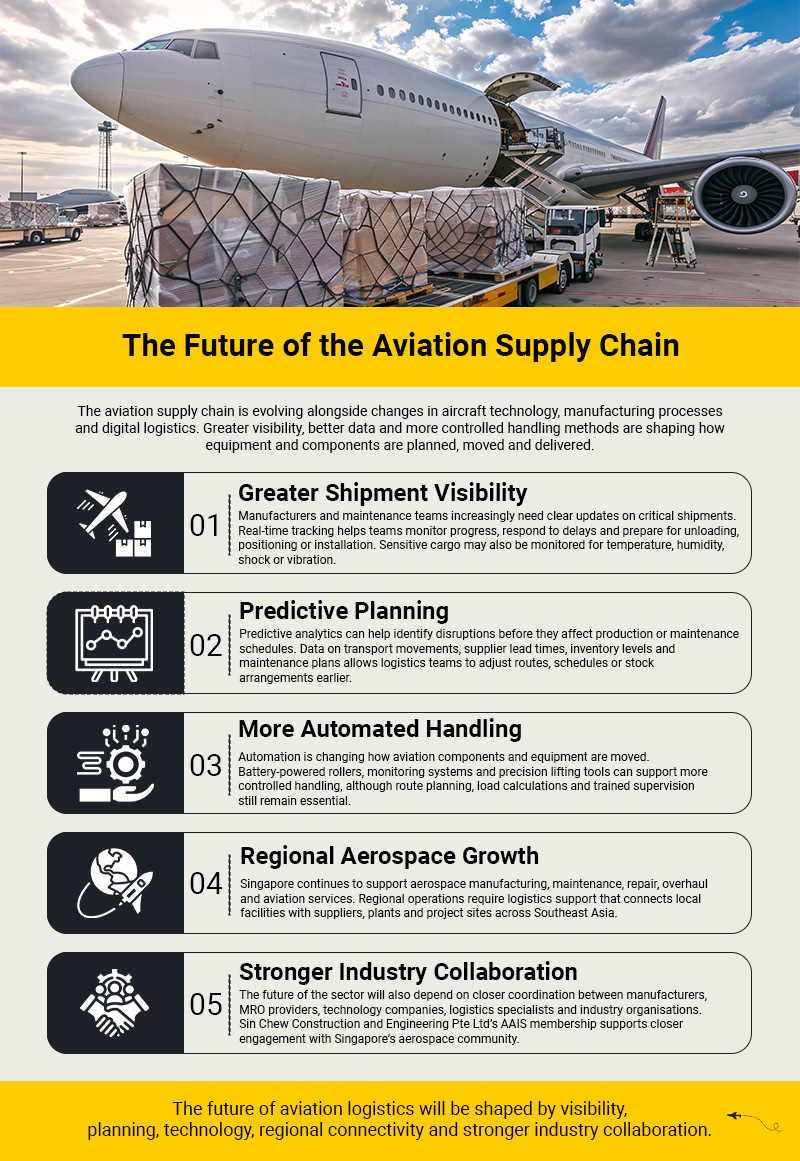
Technology is giving manufacturers, MRO providers and logistics teams better visibility over complex equipment movements. As aircraft become more advanced and aerospace facilities continue to modernise, logistics providers will be expected to deliver greater transparency, traceability and operational flexibility across the aviation supply chain. Across the aviation supply chain, the most useful developments are those that improve planning, reduce uncertainty and support more controlled handling.
Better Visibility During Transport
Real-time tracking allows project teams to follow shipment progress and prepare receiving personnel before equipment arrives. For sensitive assets, additional monitoring may record shock, vibration, temperature or humidity exposure during the journey.
This information is particularly useful during handovers. If a delay occurs, lifting teams and installation contractors can adjust their schedules rather than waiting at the site unnecessarily. Better visibility can therefore help the aviation supply chain adapt more effectively respond more quickly when plans change.
Data-Informed Route and Project Planning
Transport and route data can help identify likely constraints before mobilisation. This is particularly useful for oversized aviation equipment, where road clearance, permit timing and site access must be confirmed well in advance.
Digital planning does not replace site surveys or engineering assessment, but it can help teams identify risks earlier and compare alternative routes or delivery arrangements, improving decision-making before mobilisation begins and reducing the likelihood of avoidable disruptions.
More Controlled Equipment Handling
Battery-powered rollers, air float systems and precision lifting equipment can support movement where forklifts or cranes cannot operate effectively. This may include confined plant areas, cleanrooms or facilities with sensitive flooring.
These systems can reduce reliance on manual force, although trained supervision, load calculations and clear movement paths remain essential.
Singapore’s continued aerospace growth will also require closer coordination between manufacturers, MRO providers, technology companies and logistics specialists. Sin Chew’s AAIS membership supports closer engagement with this community and helps us stay informed about the developing operational needs of the aviation supply chain, enabling us to better align our logistics capabilities with future industry requirements and operational challenges.
Questions You Might Have
1. Why is the aviation supply chain considered so complex?
The aviation supply chain brings together manufacturers, suppliers, maintenance providers, logistics teams and regulatory authorities across multiple countries.
Each aircraft contains precision-engineered components that must be produced, transported, inspected and maintained under strict requirements. These parts often come from different suppliers and need to reach the correct facility in a carefully planned sequence.
A delay, documentation issue or handling error involving just one component can affect production schedules, maintenance work or an aircraft’s return to service, demonstrating how closely connected and interdependent the aviation supply chain has become.
2. Why can’t aviation equipment be transported like standard industrial cargo?
Many aviation components are sensitive to vibration, impact, moisture, dust and contamination. Their shape, weight and handling requirements may also make standard pallets, crates or lifting methods unsuitable.
Depending on the asset, we may need to use custom supports, shock protection, moisture barriers, engineered lifting arrangements and controlled transport.
Manufacturing and maintenance tools can require the same level of care, especially when they contain calibrated systems or need to be handled within cleanroom environments.
Because of their high value, technical complexity and operational importance, aerospace assets often require specialised handling methods that go beyond conventional industrial transportation practices.
3. What role do specialised logistics providers play in the aviation supply chain?
Specialised logistics providers coordinate aviation-related movements between manufacturers, suppliers, MRO facilities and project sites.
Their role may include assessing the asset and site, designing suitable protection, planning lifting and transport methods, coordinating permits and customs requirements, and supporting final positioning.
By managing these requirements as one connected process, an aerospace specialised logistics provider can reduce gaps between contractors and help the project proceed more smoothly, while improving visibility, coordination and risk management throughout the project lifecycle.
4. What types of aviation equipment can Sin Chew handle?
We have experience handling complete fixed-wing aircraft, helicopters and a wide range of aviation components.
Past projects have included aircraft and helicopter relocations, as well as the packing and crating of landing gear, rotor hubs, rotor blades and landing skids. We have also supported engine relocations, avionics tool movements, composite tool packing and equipment consolidation for aerospace organisations.
The right handling method depends on the asset’s size, weight, sensitivity, location and final destination.
Each project is assessed individually to determine the most appropriate protection, lifting, transportation and positioning strategy based on the operational requirements involved.
5. How are sensitive aerospace components protected during export?
Protection begins with assessing the component and the conditions it may face during handling, storage and transport.
Depending on the asset, a custom crate may include reinforced bases, shaped internal supports, shock-absorbing materials, moisture barriers and contamination protection. The design should also consider lifting, forklift access, securing and unpacking.
Electronic or calibrated equipment may require added measures, such as anti-static materials or vibration-control systems, to help protect sensitive parts throughout the journey.
For high-value aerospace assets, export packaging should be designed around the equipment’s specific geometry, sensitivity and handling requirements rather than relying on a standardised approach.
6. Can one logistics provider manage packing, transport and positioning?
Yes. A specialised logistics partner can coordinate the different stages of the move under one project plan.
This reduces handovers between contractors and helps ensure that the packing design, lifting method, transport arrangement and destination access remain aligned.
Our capabilities allow us to support these stages through a coordinated approach, particularly for complex or multi-stage equipment movements.
A single point of coordination can also improve communication, streamline decision-making and reduce the risk of issues arising between different project stakeholders.
Supporting the Safe Movement of Aviation Equipment
The aviation supply chain relies on the timely movement of aircraft, components, manufacturing tools and maintenance equipment between facilities and project sites.
Every aviation asset introduces its own operational, handling and transportation challenges. A complete aircraft may require clearance studies and purpose-planned supports, while landing gear, rotor blades or avionics tools may call for customised protection and tightly controlled handling.
Our experience with fixed-wing aircraft, helicopters, landing gear, rotor assemblies and specialised aerospace tools gives us practical experience across a range of complex movements. We apply that experience to the planning decisions that matter, including how an asset is supported, how it moves through restricted spaces and how it reaches the installation area in the required sequence.
Our AAIS membership also reflects our continued engagement with Singapore’s aerospace community, allowing us to stay closely connected to the operational, technical and logistics challenges shaping the sector.
Contact Sin Chew to discuss logistics support for aviation equipment, manufacturing machinery and other complex industrial assets. Our team can assess handling requirements, export packaging needs, site constraints and transportation considerations to develop a practical logistics solution tailored to your project requirements.